Researchers Uncover How ERDRP-0519 Differentially Targets Morbillivirus and Henipavirus Polymerases, Enabling Structure-Guided Inhibitor Optimization
A research team from the Guangzhou Institutes of Biomedicine and Health (GIBH) of the Chinese Academy of Sciences, together with collaborators from Shandong University, Wuhan Institute of Virology, Guangzhou Laboratory and Guangzhou Medical University, has elucidated the molecular basis underlying cross-genus inhibition of paramyxovirus polymerases by the antiviral compound ERDRP-0519 and developed optimized inhibitors with enhanced activity against Nipah virus (NiV).
The study, entitled “Differential inhibition of Morbillivirus and Henipavirus polymerases by ERDRP-0519 and structure-guided inhibitor optimization”, was published online in Cell on April 29, 2026.
ERDRP-0519 is a non-nucleoside inhibitor originally developed against measles virus (MeV). In this study, through structural and biochemical analyses, cell-based assays, and antiviral studies using authentic virus, the researchers demonstrated that this compound also cross-inhibits polymerases from the Henipavirus genus, including NiV, although with reduced potency.
Using cryo-electron microscopy, the researchers determined structures of polymerases from MeV, peste des petits ruminants virus (PPRV), and Nipah virus in complex with ERDRP-0519. Structural analyses revealed that ERDRP-0519 binds to a conserved pocket within the palm domain of the viral RNA-dependent RNA polymerases (RdRp). Occupation of this pocket sterically blocks RNA template and nucleotide binding, thereby suppressing viral RNA synthesis.
The structural data further revealed that ERDRP-0519 binding to the NiV polymerase requires more extensive conformational rearrangements than binding to the polymerases of MeV and PPRV, both of which belong to the Morbillivirus genus. These larger conformational rearrangements required for ERDRP-0519 binding to the NiV polymerase likely inccur a higher energetic cost, thereby reducing binding affinity and contributing to the lower inhibitory activity observed against NiV.
Based on these mechanistic insights, the researchers performed structure-guided optimization of ERDRP-0519 and generated two derivatives, GL22 and G671. Structural and cellular assays showed that the optimized compounds establish additional cross-domain interactions with the NiV polymerase, resulting in enhanced inhibition of viral RNA synthesis.
This work provides a molecular framework for understanding cross-genus inhibition of paramyxovirus polymerases and demonstrates how structural differences within a conserved drug-binding pocket can influence antiviral efficacy. The findings also establish a structure-guided strategy for the development of next-generation polymerase inhibitors against NiV and other medically important paramyxoviruses.
Dr. XUE Lu, GUI Jiacheng, GAO Shenghua, GAO Xiaoxiao, CHANG Tiancai, and PAN Hainei contributed equally to this work as co-first authors. Prof. XIONG Xiaoli and Prof. HE Jun from GIBH, Prof. ZHAN Peng from Shandong University, Prof. PEI Rongjuan from the Wuhan Institute of Virology, and Prof. CHEN Xinwen from Guangzhou Laboratory are the co-corresponding authors of the study.
The study was supported by international collaborations with Prof. RONG Lijun at the University of Illinois Chicago and Prof. Richard K. Plemper at Georgia State University. Prof. Plemper originally developed the antiviral compound ERDRP-0519.
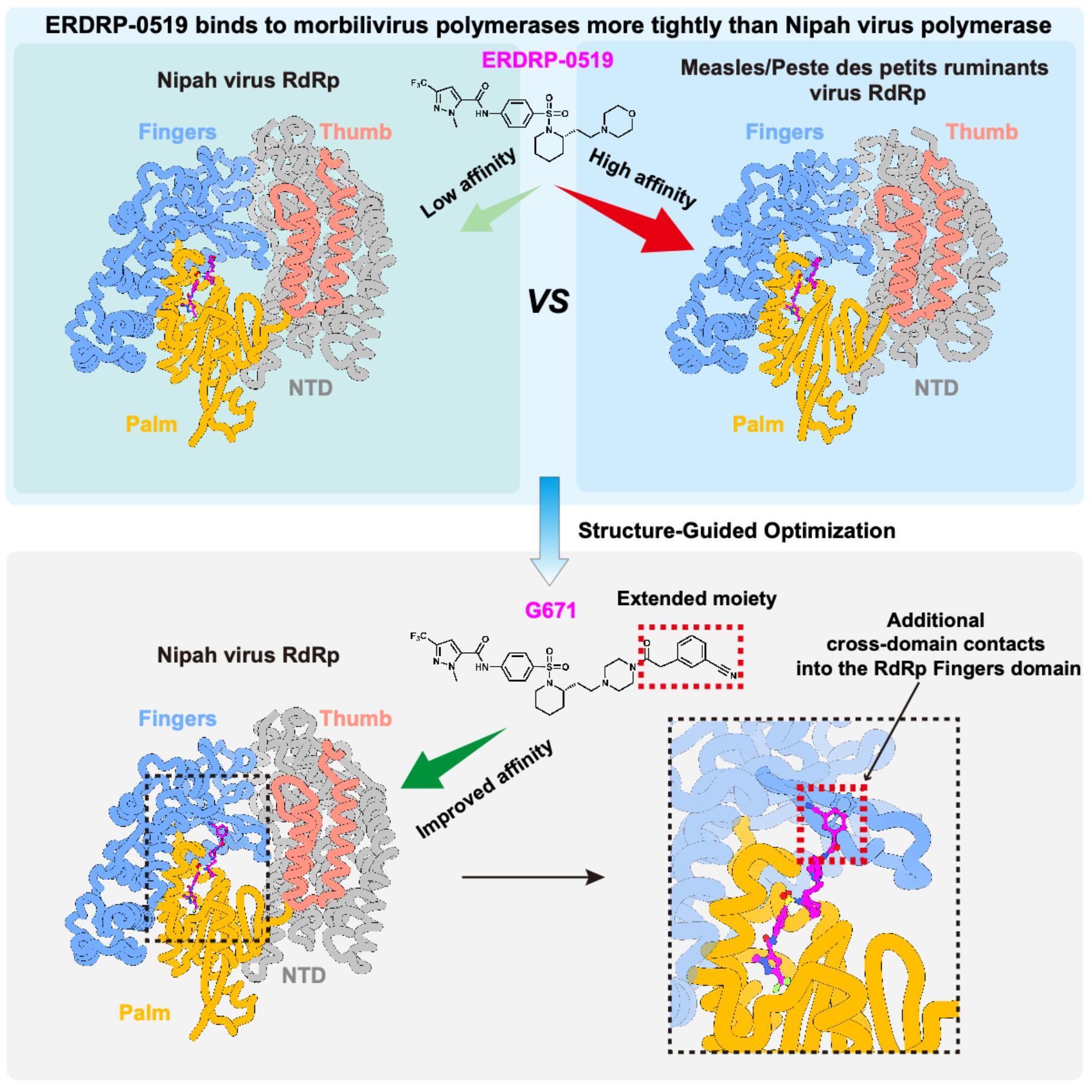
Figure 1. ERDRP-0519 binds Morbillivirus polymerases with higher affinity than the Nipah virus polymerase. Guided by structural insights, the optimized derivative G671 incorporates an extended chemical moiety that establishes additional cross-domain interactions within the polymerase, resulting in improved binding to the Nipah virus polymerase.
Contacts:
XIONG Xiaoli, Ph.D., Principal Investigator
Guangzhou Institutes of Biomedicine and Health, Chinese Academy of Sciences, Guangzhou, China, 510530.
Email: xiong_xiaoli@gibh.ac.cn
Attachment Download:
-
ContactXIONG Xiaoli, Ph.D.xiong_xiaoli@gibh.ac.cn
-
Reference
-
Related Article