Researchers develop a mitochondrial transplantation approach for mitochondrial and degenerative diseases
A recent study from LIU Xinguo’s group was published in Cell entitled “Transplantation of encapsulated mitochondria alleviates dysfunction in mitochondrial and Parkinson's disease models”.
Mitochondria, the powerhouse of cells, are essential for human health. Mitochondrial dysfunction underlies numerous major diseases, including neurodegenerative diseases, diabetes, hepatic diseases, ophthalmic diseases, and aging. Mitochondrial diseases represent a unique class of genetic disorders that can arise either from defects in nuclear genes encoding mitochondrial proteins or from mutations in mitochondrial DNA (mtDNA). Beyond symptomatic management, effective treatment for mitochondrial diseases remains a global challenge. While mitochondrial transplantation—delivering healthy mitochondria to compensate for cellular defects and reduce mtDNA mutation load—is widely regarded as a promising therapeutic direction, achieving safe and efficient transplantation has remained unsolved.
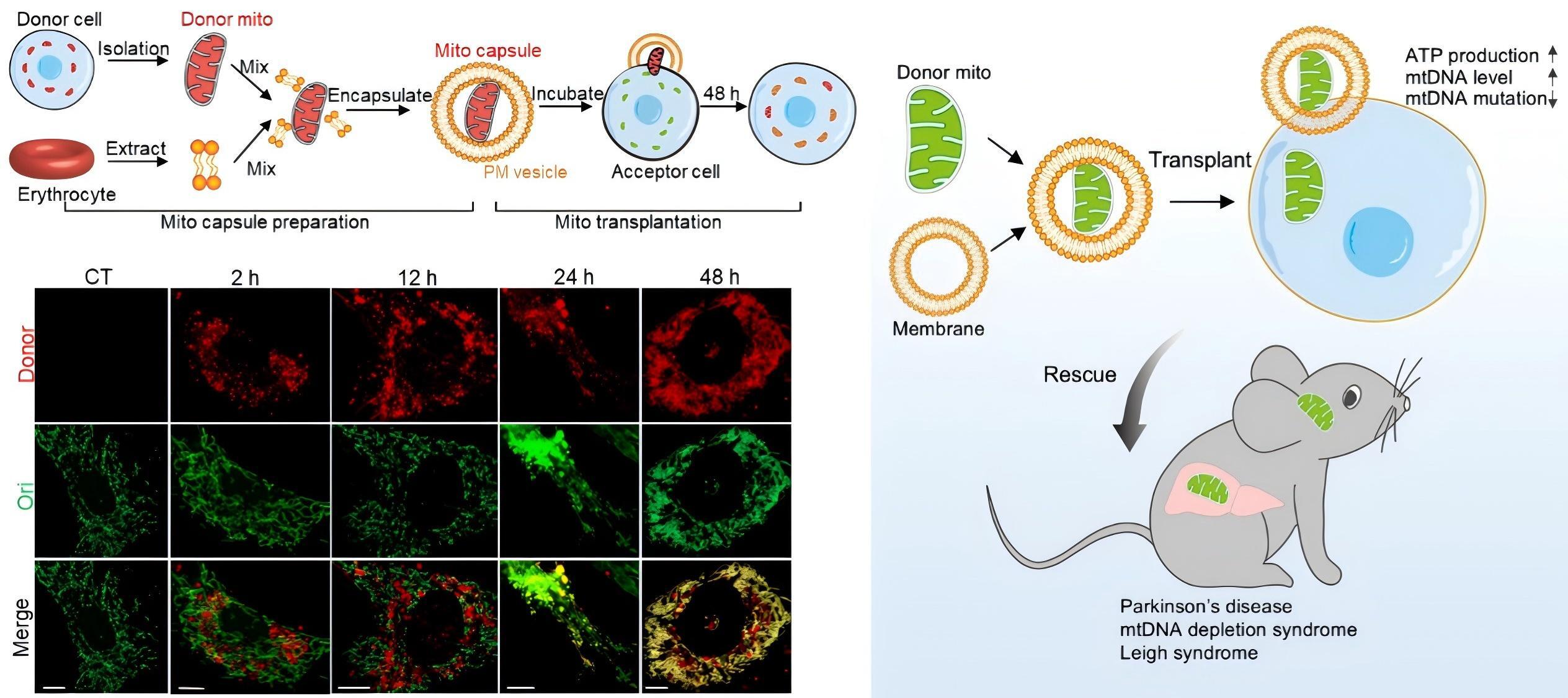
To address this critical challenge, the research team developed an innovative approach: encapsulating healthy mitochondria within vesicles derived from red blood cell membranes. These "mitochondrial capsules," approximately 1 micrometer in diameter, protect the mitochondria during delivery and facilitate their efficient entry into target cells, achieving an approximately 80% transplantation efficiency in cultured cells. Donor mitochondria fuse with the recipient cell's own mitochondrial network, ensuring long-term survival and function.
Next, the research team used three classical mitochondrial defect cell models: Rho 0 cells completely lacking mtDNA, and patient-derived cells carrying mtDNA deletions or point mutations. Results showed that transplanted healthy mitochondria integrated with the endogenous mitochondrial network. Treatment with encapsulated mitochondria complemented the loss, deletion or mutation of mitochondrial DNA, thereby rescuing the associated bioenergetic and biochemical defects in patient-derived cells with mitochondrial disorders.
Furthermore, the research team evaluated the therapeutic potential of mitochondrial capsule transplantation in vivo using murine and monkey models. In Ndufs4 knockout mice—a model of Leigh syndrome—mitochondrial capsule transplantation significantly improved motor performance and prolonged survival. In DGUOK knockout mice, which recapitulate mitochondrial DNA depletion syndrome, treatment restored mtDNA copy number in hepatocytes and ameliorated hepatic dysfunction. Furthermore, in a pharmacologically induced mouse model of Parkinson’s disease, mitochondrial capsules rescued neuron loss, improved motor skills and restored mitochondrial function in the affected brain regions.
This study demonstrates the potential of mitochondrial capsules for treating mitochondrial disorders and proposes an "organelle therapy" strategy to regenerative medicine.
Contacts:
LIU Xingguo, Ph.D., Principal Investigator
Guangzhou Institutes of Biomedicine and Health, Chinese Academy of Sciences
Guangzhou,China, 510530
Email: liu_xingguo@gibh.ac.cn
Attachment Download:
-
ContactLIU Xingguo, Ph.Dliu_xingguo@gibh.ac.cn
-
Reference
-
Related Article