Researchers identify a Non-canonical ORF-encoded Microprotein PLUM as a Key Regulator of Pluripotent Stem Cell Fate
A recent study from LIU Xinguo’s group at the Guangzhou Institutes of Biomedicine and Health, Chinese Academy of Sciences, was published in Nature Communications, titled “Microprotein PLUM encoded by Lin28b uORF is a cytoplasmic determinant of pluripotency and embryonic development.” The work reports that selective translation of an upstream open reading frame (uORF) located in the 5′UTR of the pluripotency‐associated metabolic factor Lin28b gives rise to an 85-amino acid microprotein, named PLUM (Pluripotency-associated Lin28b uORF-encoded Microprotein). Deletion of PLUM forces mouse primed pluripotent stem cells (PSCs) to convert to the naïve state with nearly 100% efficiency and causes severe implantation defects in embryos. This study identifies PLUM as the first functional microprotein encoded by a non-canonical ORF in pluripotent stem cells and establishes it as a key link connecting RNA regulation and metabolic remodeling during pluripotency and early development.
Metabolic regulation and mRNA translation are tightly coordinated processes essential for cellular plasticity. During pluripotent state transitions, metabolic rewiring is accompanied by dynamic changes in ribosome biogenesis and protein synthesis. Although global translation is relatively low in PSCs, widespread selective translation occurs in non-coding regions, including numerous non-canonical ORFs. These ORFs are often considered cis-regulatory elements controlling downstream translation, but whether they encode functional proteins that actively participate in pluripotency regulation has remained largely unexplored.
Using PSC and mouse models, the authors demonstrate that loss of PLUM almost completely drives the transition of primed PSCs into the naïve state and markedly compromises embryo implantation, underscoring its decisive role in cell-fate control. Mechanistically, PLUM directly interacts with the RNA-binding protein L1td1 and regulates its cytoplasmic condensates and phase-separation behavior. PLUM deletion reshapes the RNA-binding profile of L1td1, increasing the stability of naïve pluripotency transcripts, such as Tfcp2l1 and Zfp42, and promoting the activation of oxidative phosphorylation genes. In parallel, loss of PLUM disrupts P-bodies responsible for mRNA decay, which are enriched for transcripts encoding mitochondrial complex I and V subunits, suggesting that PLUM modulates mitochondrial function through P-body assembly.
Together, this work reveals a previously unrecognized role of a non-canonical ORF-derived microprotein in pluripotency control and embryonic development. It uncovers a mechanism that integrates RNA regulation, biomolecular condensates, and mitochondrial metabolic remodeling, offering new conceptual insights into PSC fate determination and providing potential targets for improving pluripotent state optimization and embryo quality in assisted reproduction.
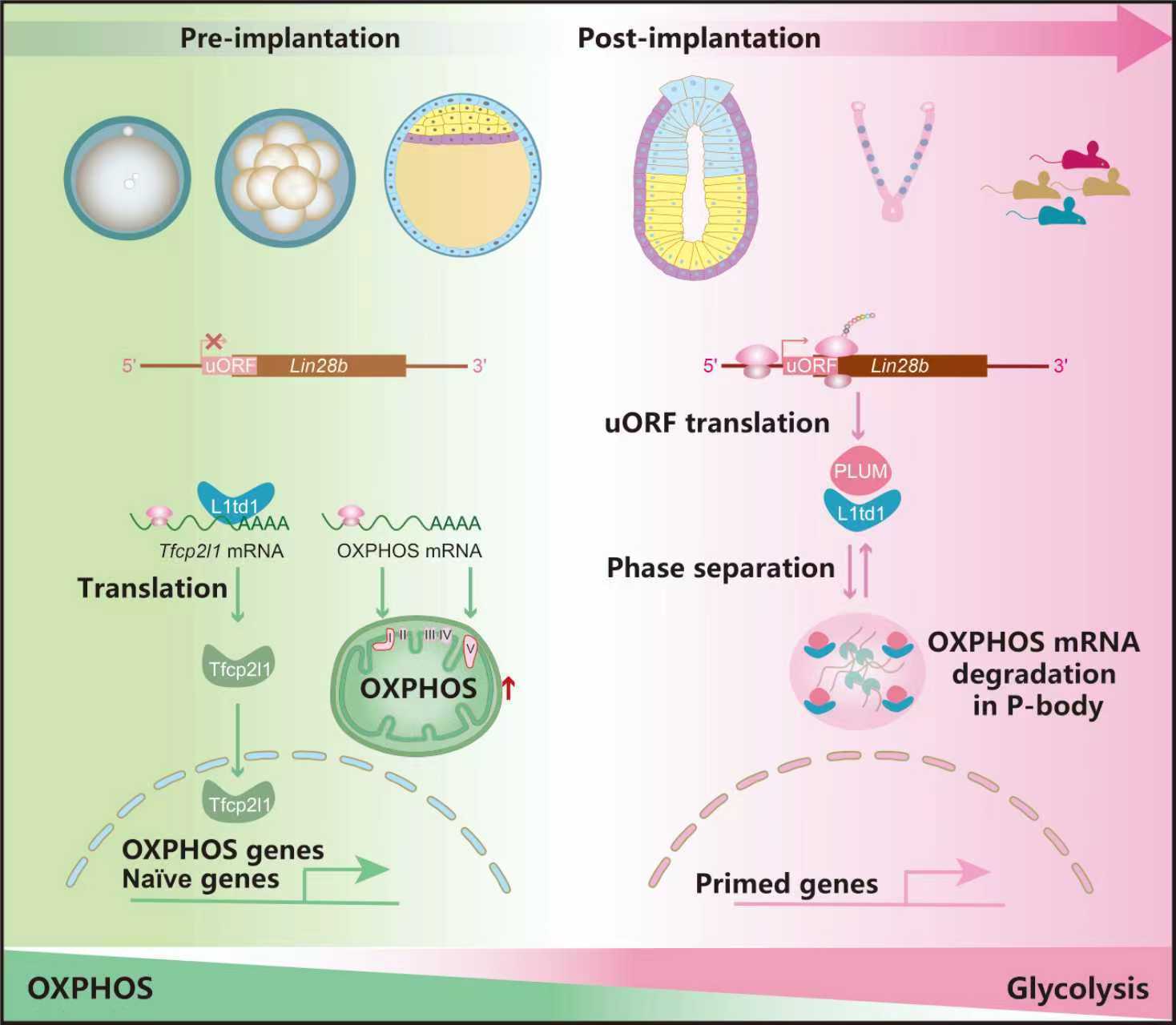
Image by Prof. LIU's team
This study was jointly conducted by researchers from the Guangzhou Institutes of Biomedicine and Health, the CAS Hong Kong Institute of Innovation, Tianfu Jincheng Laboratory, Guangzhou Medical University, The Chinese University of Hong Kong.
Contacts:
LIU Xingguo, Ph.D., Principal Investigator;
Guangzhou Institutes of Biomedicine and Health, Chinese Academy of Sciences, Guangzhou, China, 510530.
Email: liu_xingguo@gibh.ac.cn
.
Attachment Download:
-
ContactLIU Xingguo, Ph.Dliu_xingguo@gibh.ac.cn
-
Reference
-
Related Article